

Which Flotation Sorting Different Fluorite Ore Types

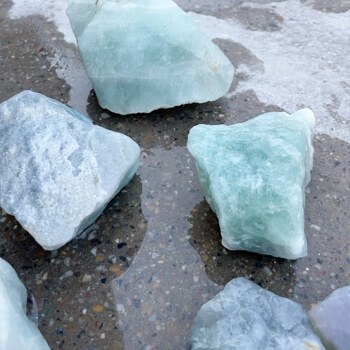
It mainly comprises fluorite (about 85%) and quartz, with only a small amount of calcite, barite and sulfide. Reducing silicon in concentrates is the focus of this type of ores, and the requirements for silicon content vary according to different usage requirements. In the process of beneficiation, grinding is a factor that greatly affects the flotation of quartz-type fluorite ore, and it is necessary to dissociate the quartz and fluorite monomers through grinding. Since most quartz-type fluorite ores have conjoined bodies of quartz and fluorite, the grinding particle size is too fine, leading to excessive fluorite crushing and affecting the recovery rate. Therefore, the stage grinding process is generally adopted, which reduces the silicon content of the concentrate product after fluorite flotation and increases the recovery rate of the fluorite concentrate. Using the process flow of stage grinding stage flotation, high-grade fluorite concentrate can be obtained after multiple selections.
This type of fluorite ore can be divided into two types, coarse-grained and fine-grained, according to the embedded characteristics of useful minerals.
1. Coarse-grained embedded fluorite is easy to select, using fatty acid collectors, ore slurry adjuster as sodium carbonate, quartz inhibitor as water glass, and high-quality fluorite concentrate can be obtained through a coarse-multiple refining process.
2. The flotation reagents of fine-grained embedded ore are the same as those of coarse-grained embedded quartz-type fluorite ore. However, due to the fine particle size embedded in the target minerals, it is necessary to strengthen the grinding, and the staged grinding stage is adopted for the separation process.
Quartz-fluorite type ore beneficiation process: raw ore crushing-grinding-roughing-rough concentrate regrinding-multiple selection.